Showing posts with label fabrics patterns and designs. Show all posts

Thursday, June 18, 2009

How The West Was Fun


Yipee-i-o! Southwest and Western decorating has become an iconic American classic combining the rich hues of the desert with cultural influences of Native American, Mexican, and Spanish design to create comfortable and inviting living spaces.

Inspired by nature, earthy neutrals, warm reds, rich browns, sage greens, and classic golds mixed with bold and interesting textures come together to exemplify a style reflecting the timeless beauty of the great American West.
You don't have to live in the southwest to enjoy southwestern style. Whether you choose classic western, cowboy chic, territorial, or a combination of styles, this casual and eclectic decor can be adapted to any home and any lifestyle.

Wednesday, May 13, 2009

Citron-elation


I love color! Color makes me happy and color makes me smile! And, there is no livelier color than Citron. Citron is a hybrid of color blending spring green with a dose of sunny yellow. It is bright and perky and can punch up and invigorate almost any color pallette.


For a vibrant and fresh look, this traditional stylized floral pattern has been updated with citron and dose of coral, rasbery, and cool whites.


To add a bit of contemporary sophistication, pair citron with seal brown and aqua blue.


From grassy green to chartruese, citron can update and enliven almost any room decor.

Wednesday, February 4, 2009

Everything you wanted to know about Jacquards, but were afraid to Damask


I am often asked this question; “What is the difference between Jacquards and Damasks?”

First, it helps to understand the fabric terms “warp” and “weft.” Simply speaking, the warp yarns are placed first on the fabric loom running the length of the fabric bolt. The weft yarns are woven through running selvage to selvage across the fabric bolt to create fabric patterns. Together, they make up the two types of yarns used to create woven fabrics.

Now we can move on to Damasks. The patterns in damasks are formed by the weaving of different yarns used to create designs in the fabric. An example of this would be a ground in a twill weave and a contrasting design in a satin weave. Damask fabrics are flat and reversible with the patterns loomed into the cloth.

Jacquards are named after the Jacquard Loom, the mechanical - and now computerized - looms used to create the complex patterns woven into the fabric. The Jacquard Loom has automated the production of an unlimited variety of patterns in the weaving process and has made it possible to produce many different weaves from one warp.

This is why Damask fabrics can be Jacquards – since they are woven on a Jacquard Loom and why Jacquard fabrics are not limited to Damasks. I’ll bet now you will look at your draperies and table linens in a whole new way.

Saturday, January 17, 2009

The Persian Pickle


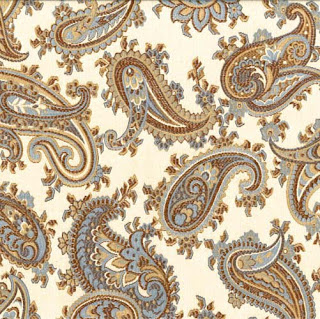
As I was moving fabrics around the store today, I was struck by the large number of paisley patterns we have. I admit it. I love paisley. It is neither feminine nor masculine and it holds a timeless appeal.

The history of paisley is really quite interesting – although it might resemble a twisted and ornate teardrop, an embellished kidney, a giant decorative comma, or to me, an amoeba on steroids, it is really an ancient Persian Zoroastrian symbol combining a stylized floral spray and a cypress tree symbolizing life and eternity. The Persian word for paisley is “boteh” and the pattern has been used for over 500 years to decorate not only royal garments, but textiles used by the general population as well.

During the first half of the 17th century, the East India Company imported paisley from India and a new East meets West fashion statement was born. During the 19th century, British soldiers returning from the Indian colonies brought the pattern home with them in the form of wool cashmere shawls and in the Scottish town of Paisley, the patterns were reproduced on hand and jacquard looms and the modern name of “paisley” was born.

Fast forward to the 1960’s…. Paisley took on an almost a rebellious symbolism as it became a popular design during the Summer of Love in 1967. Even the Beatles got into the act when John Lennon painted a Rolls Royce with the Paisley pattern. At one time, Fender Guitars made a Pink Paisley Telecaster guitar by attaching paisley wallpaper onto the guitar bodies for the fashion forward rock ‘n roll crowd.

Now, with its hint of Asian timelessness, paisley patterned textiles remain popular as ever, used in both traditional and contemporary settings. This is one fashion trend made to last.